Qubere Regulatory Intelligence
Know a rule changed
before it changes your landed cost.
A live Federal Register feed, tagged automatically, joined against your real products and open shipments to compute an actual dollar duty-delta — not a newsletter someone forwards after the fact.
The problem
Trade rules change constantly. Most teams find out from a broker email.
What a trade compliance lead says about regulatory change today:
"We read about a Section 301 change days after it took effect — from a PDF someone happened to open."
No live feed
"Even when we see a notice, nobody checks it against our actual catalog. We just guess if it matters."
No portfolio matching
"I want a dollar number, not a paragraph of legal text I have to interpret myself."
No quantified exposure
How Qubere addresses it
A feed that tags itself. An engine that prices the impact — on real rows, not a guess.
- A scheduled job pulls CBP-scoped documents straight from the Federal Register API, deduped by document number — not a manually curated list.
- Each new notice is tagged — type, affected HTS codes, effective date, action required — by an AI extraction pass, with a keyword-regex fallback if the model call fails.
- On demand, a deterministic engine — no LLM involved — joins the notice's HTS codes against your real products, open shipments, and drawback lots, and computes an actual dollar duty-delta from real rate-change records.
- Impacted in-progress shipments get a real compliance exception opened automatically — the notice doesn't just sit in a feed, it surfaces where the work already happens.
Regulatory feed
Filter by HTS code, not by reading every notice.
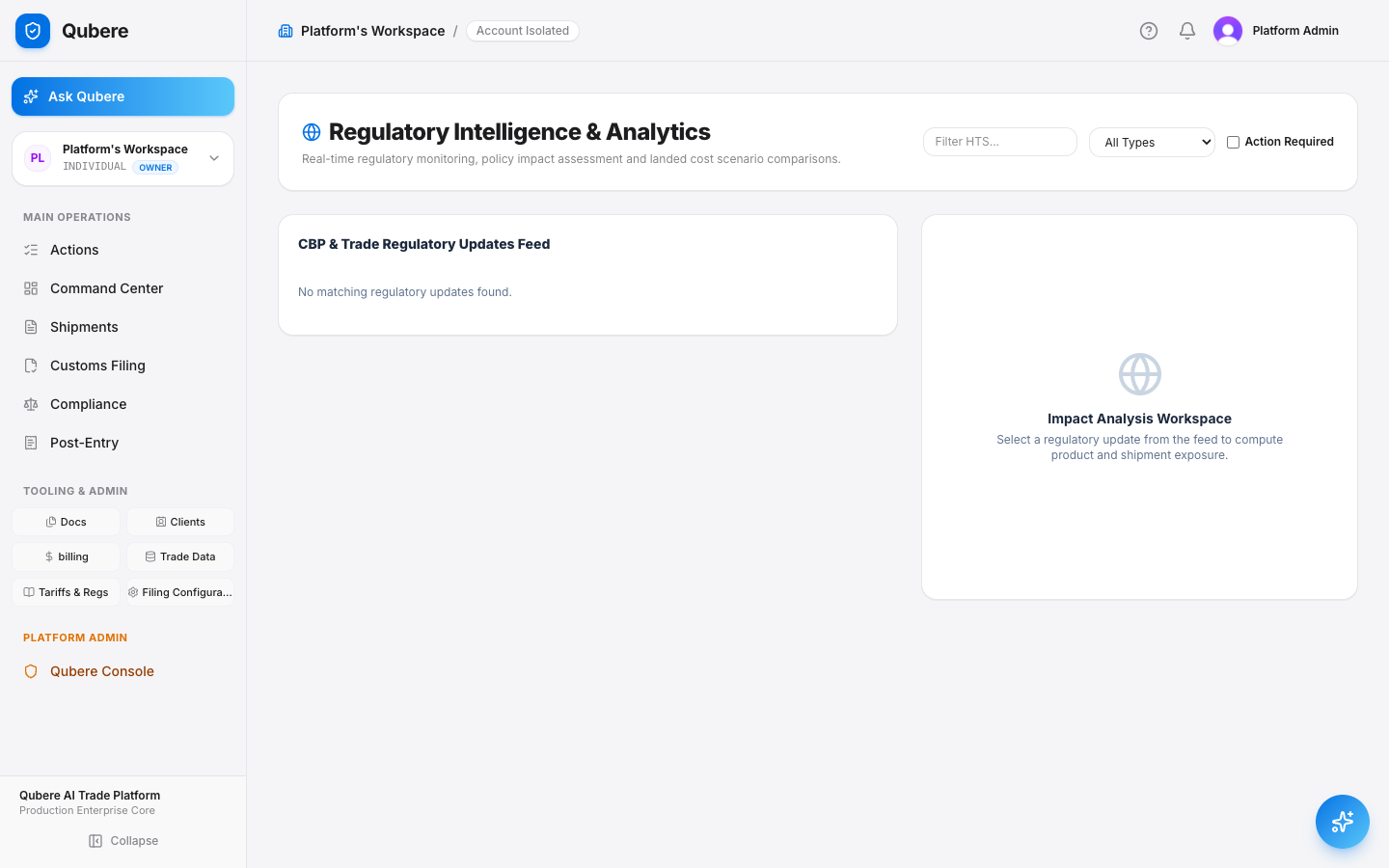
The feed pulls live from the Federal Register, filtered to CBP-scoped documents. Filter by subject, publisher (CBP, USTR, BIS, USITC, Section 232, CBP CSMS), requires-review, or a specific HTS code against each notice's tagged codes — instead of scanning every entry for relevance. Official CBP CSMS bulletins can be added by URL; they land as review-required advisories and never clear, block or change a filing on their own. A linked PGA Import Requirements page tracks official CBP ACE PGA source documents and what changed.
Ingest & tagging
The AI's job is triage, not the final word.
Every new Federal Register document is deduped by document number, then fetched in full and run through an extraction pass that pulls out type, affected HTS codes, effective date, and whether action is required. If the model call fails, a keyword/regex fallback still tags it — the feed never goes empty because a model call timed out.
- Title/abstract-level extraction only — no automated legal-text parsing, and no refund claim is ever auto-created from a tag
- A human always confirms the match against the actual filing before any downstream action
Impact analysis
A real dollar number, not an LLM's guess.
Click "Assess Impact" and a deterministic rules engine — no model call in this step — matches the notice's HTS codes against your real classified products, your open (not liquidated or closed) shipments, and affected drawback lots, then computes the estimated duty delta as customs value × rate change, summed line by line.
- Rate deltas come from real HTS rate-change records, not an assumption
- Paginated workspace: which products, which shipments, which lots, and the dollar exposure on each
| SHP-2026-000091 | $212,000 value | +$4,240 |
| SHP-2026-000144 | $96,500 value | +$1,930 |
From notice to workbench
The impact doesn't stay in a report — it shows up where the work happens.
Running the impact analysis doesn't just render a number: for every affected in-progress shipment, a real compliance exception is opened on that shipment, and the notice's total affected-shipment count is saved back to the notice record. The next person to open that shipment sees the regulatory flag without having read the Federal Register at all.
- Exception is blocking — it participates in the same readiness gate every other exception does
- affectedShipmentsCount persists on the notice, so it's visible from the feed without re-running the analysis
Objection handling
Every hard question, answered directly.
| "Does the AI just decide our duty exposure and file a claim on its own?" | No. The AI only tags incoming notices for triage. The dollar exposure comes from a deterministic HTS-match and rate-change join with no model in the loop, and no refund claim is ever auto-created — a human confirms the match first. |
| "What if the notice extraction gets it wrong or the model is down?" | A keyword/regex fallback still tags the notice with HTS-looking codes, so the feed keeps working without the model. Extraction is title/abstract-level triage, not a substitute for reading the actual filing. |
| "How do we know which of our shipments are actually affected?" | Impact analysis joins the notice's tagged HTS codes against your real Product, Shipment, and DrawbackLot records and opens a real blocking exception on every affected open shipment — not just a count in a report nobody opens. |
The close
"The rule changed. Here's the dollar number, and here's exactly which shipments it hit."
A live feed, tagged automatically, priced deterministically against your real catalog — not a newsletter you have to interpret yourself.
Next step: open Regulatory Changes, run impact analysis on a real recent notice, and show the affected shipment list and dollar delta land from your customer's own data.