Qubere Post-Entry Management
Filing an entry isn't the finish line.
Seven statutory clocks start right after.
CBP Reconciliation, Duty Statements, Duty Statement Payments, Filer Admin Health, Prior Disclosure, Protests, and Post-Summary Corrections — each with its own deadline math, eligibility rules, and lifecycle, in one hub instead of seven disconnected spreadsheets.
The problem
Every post-entry deadline lives in a different person's head — or nobody's.
What a compliance manager says about post-entry work today:
"We found out a protest window closed by missing it, not by a system telling us it was 30 days out."
No deadline visibility
"Nobody checks our fatal-error rate against the 5% ABI threshold until CBP flags it."
No compliance monitoring
"Our 1592 penalty exposure lives in a spreadsheet someone built once and never updates."
No repeatable calculation
How Qubere addresses it
Seven real statutes. Seven real clocks. One hub that computes each one for you.
- Every deadline is computed from the actual entry, liquidation, or lading date — not typed in by hand and left to go stale.
- Urgent items surface automatically: protests within 30 days of their statutory deadline, PSC windows closing within 7 days.
- Eligibility checks are real cross-references — a PSC can't be filed against a line item with an active drawback claim on it.
- Full create-to-close lifecycles for the workflows that need one, not just a read-only status page.
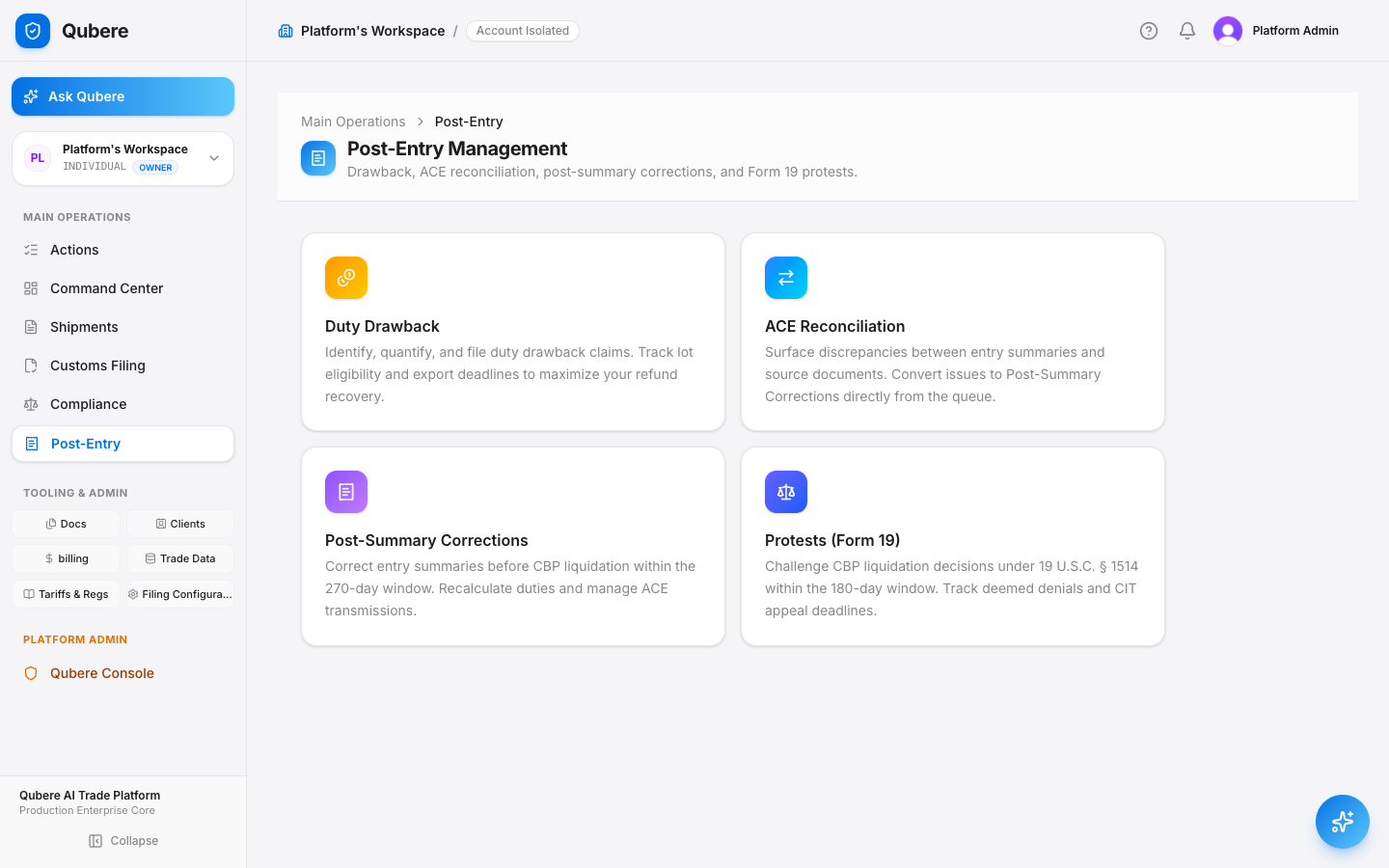
Post-Entry hub
Seven statutory workflows, one landing page.
Reconciliation, duty statements and payments, prior disclosure, protests and PSC each get their own tile on the Post-Entry & Recovery hub, alongside duty drawback and entry reconciliation from a single entry point — no more remembering which corner of the app a given post-entry task lives in.
Flag now, bundle and transmit later
21 months to fix the number you didn't have at entry.
Flag an entry for value, classification, FTA eligibility, or 9802 at the time you file — the reconciliation deadline is computed from that entry's date, and a bundled reconciliation entry inherits the earliest deadline of everything inside it.
- Flag → withdraw → bundle into a reconciliation entry → transmit, all in one screen
- Distinct from ACE statement reconciliation elsewhere in the app — this is entry-level flagging under the CBP Reconciliation Program
| RECON-2026-0018 | 3 entries | prepared |
| RECON-2026-0011 | 7 entries | transmitted |
PMS & daily statement deadline math
Knows the 15th working day is never just the 15th.
Periodic Monthly Statement deadlines are computed by walking business days — skipping weekends — to land on the true 15th working day of the following month; daily statements get the next business day. Every payment instruction runs through a real lifecycle, not a static status field.
- Lifecycle: Pending → Scheduled → Submitted → Settled / Failed / Cancelled
- Only the last 4 digits of the bank account are ever stored
| Statement | Type | Deadline | Status |
|---|---|---|---|
| PMS-2026-08 | Monthly | 2026-09-15 (15th working day) | Scheduled |
| DS-20260909 | Daily | 2026-09-10 | Settled |
Filer Admin Health
The 5% fatal-error ceiling, watched continuously instead of discovered by CBP.
A rolling 30-day window tracks every ABI export's outcome and computes your live fatal-error rate against the regulatory 5% ceiling, alongside ABI credential and connection status — a read-only compliance dashboard, always current.
- Fatal-error rate, export volume, ABI environment, credential status, transport protocol, last error — one screen
- HEALTHY / WARNING / NON_COMPLIANT verdict derived from the actual export history
Duty Statements
The statements CBP bills you on, and the ones still missing.
Daily and Periodic Monthly Statements from CBP sit beside Duty Statement Payments. Each statement shows its payment instruction (status and deadline) or a link to set one up with the statement's number, type, date and filer already filled in. Statements still missing a final are called out, and you can ask CBP to send one again.
- Statements and Payments share a switcher, so the bill and its payment instruction are one click apart
- A reroute request to CBP is tracked: waiting, acknowledged, refused, or answer unreadable
- Viewing needs billing.payment.view; asking CBP to resend needs billing.payment.record
| Statement | Type | Payment | Status |
|---|---|---|---|
| Illustrative | Daily | Instruction set | final received |
| Illustrative | Monthly | Set up payment | needs attention |
Prior Disclosure
The penalty-exposure spreadsheet, but it's actually maintained.
Enter culpability level, duty loss, entered value, and years elapsed — get a real statutory-cap calculation before you decide whether to disclose: fraud caps at domestic value, gross negligence at 4× duty loss or 40% of value, negligence at 2× duty loss or 20% of value, each collapsing to interest-only or duty-only once a valid disclosure is on file.
- Preview the exposure without saving, then record the disclosure when you're ready
- Lifecycle: Draft → Tendered → Acknowledged → Closed
Protests
180 days from liquidation. Qubere won't even let you create one that's already dead.
The protest deadline is computed from the entry's actual liquidation date the moment you start a new protest — and creation is rejected outright if that window has already closed, instead of silently accepting a doomed filing. Anything within 30 days of its deadline surfaces as urgent on the list view automatically.
- Full lifecycle: file with CBP, request Further Review, add notes, withdraw
- Tracks Further Review Petition and deemed-denial status alongside standard outcomes
| Protest | Grounds | Deadline | Status |
|---|---|---|---|
| PROT-2026-0044 | Classification | 2026-09-28 | urgent |
| PROT-2026-0031 | Valuation | 2026-11-02 | filed |
Post-Summary Corrections
Won't let a PSC and a drawback claim collide on the same line item.
Eligibility is checked against the entry's actual PSC window — a stored 270-day deadline tied to the shipment, not a guess — the filing status (must be Accepted, Released, or Liquidated, not Closed), and whether any line item already has an active drawback claim against it. Windows closing within 7 days surface as urgent automatically.
- Full lifecycle: create → ready-for-review → submit to ACE → withdraw
- Cross-checks drawback claims before allowing a correction — the two workflows can't silently conflict
| PSC | Correction | Window closes | Status |
|---|---|---|---|
| PSC-2026-0102 | Value adj. | in 5 days | urgent |
| PSC-2026-0088 | HTS correction | in 61 days | ready |
Objection handling
Every hard question, answered directly.
| "Does this actually pay CBP or process the ACH transfer?" | No — Duty Statement Payments computes the correct working-day deadline and tracks the payment lifecycle end to end; it does not move funds itself. It's the compliance layer around your existing payment process. |
| "Is drawback part of this?" | Drawback recovery lives in its own workspace, covered in the Duty & Landed-Cost deck — this is the seven other statutory post-entry workflows, and PSC explicitly checks against active drawback claims so the two never silently conflict. |
| "What happens if we try to protest something already past its deadline?" | Creation is rejected outright — the 180-day window is computed from the real liquidation date at creation time, not left for someone to notice later. |
The close
"Every clock computed. Every eligibility check real. One hub for what happens after filing."
Seven statutes, seven workflows, zero spreadsheets.
Next step: open Post-Entry, start a new protest against a long-liquidated entry, and show the deadline check reject it before it can even save.