Qubere

Agentic Customs and
Compliance Platform

AI-native customs filing and global trade compliance — combining specialized agents, deterministic controls, human review, continuous monitoring, and audit-ready evidence.

Agentic Customs Operating Model

Qubere AI Copilot coordinates the compliance experience while domain agents and deterministic engines execute classification, screening, licensing, monitoring, and customs workflows with traceable evidence.

Key features

Solution at a Glance

A unified Agentic Customs and Compliance platform spanning customs operations, AI-assisted decisioning, deterministic compliance controls, continuous monitoring, governance, and reporting.

Qubere AI Copilot for Compliance
Grounded assistant for explaining compliance decisions, evidence, shipment readiness, exceptions, and next actions across the platform.
Command Center
Shipment readiness, agent decisions, exceptions, tasks and regulatory signals.
Document Intelligence
AI-assisted extraction (with an accuracy feedback loop and per-account "Qubere Learns" memory), normalization, validation, drag-to-correct ("Qubere Magic Marker"), human-confirmed splitting of merged trade documents, account-specific Document Rules Studio, source-of-truth field precedence for conflicting documents, one-click field explanations, and correction-learning rule suggestions.
Classification Agent
HTS/tariff classification with reference-data grounding and human-review policy.
Restricted Party Screening
Canonical RPS, red flags, review workflow and pre-approved party reuse.
Network & Ownership Intelligence
Relationship graph traversal, vessel identity, ownership-percentage attribution and auto-triggered EDD casework.
Embargo & Trade Controls
Country embargo, forced labor/UFLPA, end-use/end-user and anti-boycott checks.
License Controls
Export/import determination, license portfolio, utilization and alerts.
Community & Bulk Screening
Ad-hoc multi-party and enterprise batch compliance screening.
Continuous Party Monitoring
RDPS change-impact re-screening, transitions, alerts and review.
Reference & Regulatory Intelligence
OFAC/BIS/UFLPA/Dow Jones content, change tracking and regulatory updates.
Governance & Reporting
Overrides, audit, notifications, usage metering, scheduled reports and RBAC.
Post-Entry & Continuous Monitoring
ISF 10+2, prior disclosure, CBP reconciliation and filer-admin health, plus continuous AD/CVD case and bond-sufficiency sweeps.
FTA & Trade Agreement Qualification
Deterministic tariff-shift/RVC rules qualify products for USMCA, CAFTA-DR, KORUS and GSP, with opportunity discovery, a human decision gate, and certificates of origin.
CBAM Carbon Border Exposure
EU/UK CBAM cost exposure, Cost Radar and Calculator, with versioned regulatory data that live-fetch stages but never auto-activates.
Assistant Grounding & Staleness
A persistent per-client knowledge graph grounds the Copilot; approved classifications carry a first-class stale-input state when their source data moves.
Address Intelligence
Live address autocomplete across party, client onboarding and portal forms, backed by a verified geocoding provider.
AI Model Routing & Governance
Tenant-aware model routing across compliance agents, with admin-pinned model overrides and transparent platform-fallback messaging.
Live product screenshot

Agentic operations

Command Center & Qubere AI Copilot

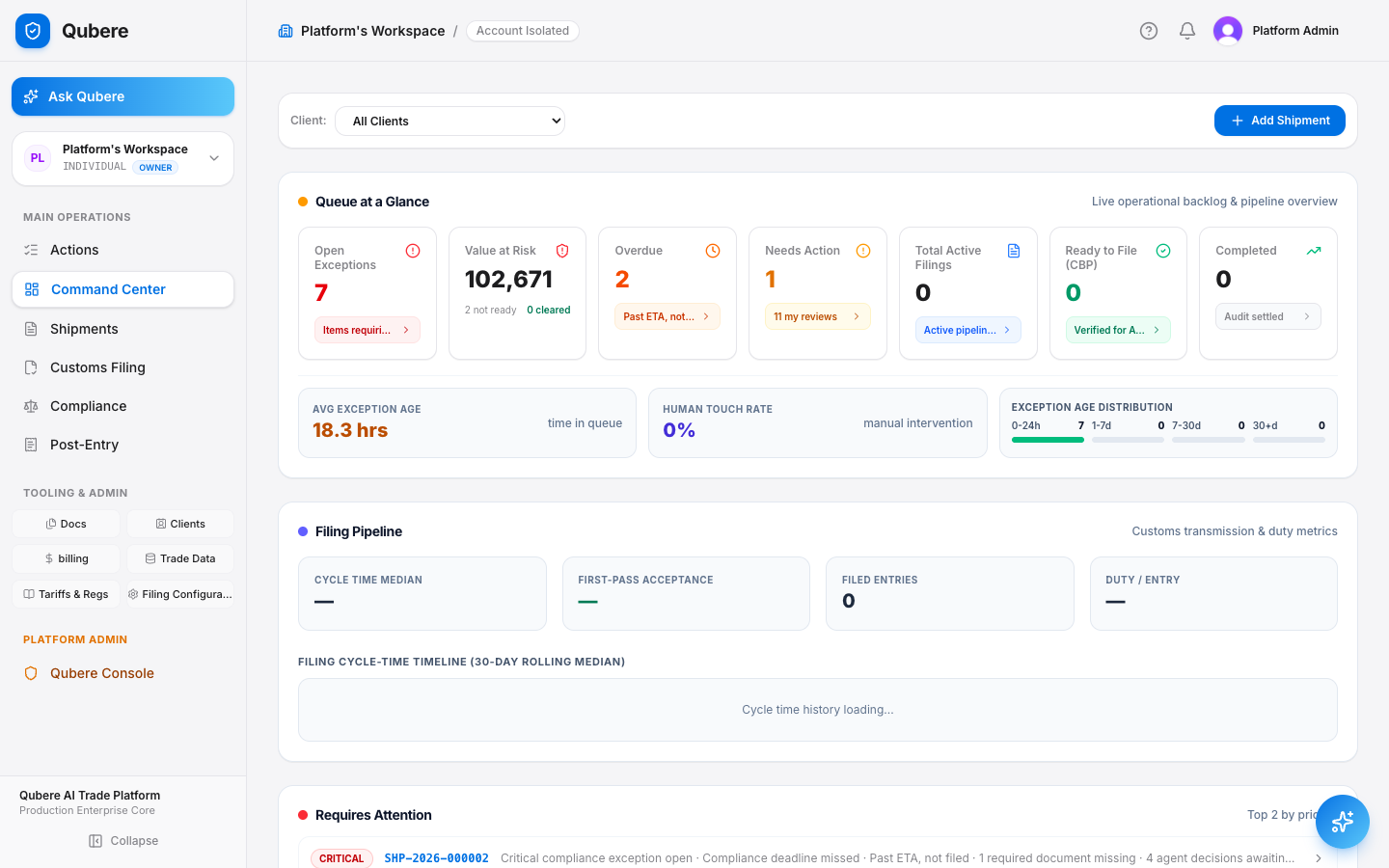
The operational control plane combines shipment readiness, agent decisions, exceptions, tasks, regulatory signals, and a grounded compliance copilot.

  • Shipment readiness from real line items, values, classifications and required/missing documents
  • Agent decisions summarized into verified, needs-review and blocked states
  • Severity-driven exception queues with assignments, reviewer actions and formal overrides
  • Regulatory signals and open compliance deadlines surfaced into daily operations
  • Per-shipment stage stepper tracks work-management progress from intake through filing
Operating principle
The Copilot is grounded in persisted Qubere evidence; it does not calculate or replace deterministic regulatory decisions.
Qubere Command Center dashboard showing live queue, filing pipeline, and shipments
Live product screenshot

Customs execution

Customs Filing & Document Intelligence

Qubere connects document intake, shipment data, classification, compliance checks, exceptions and filing readiness in one Agentic Customs workflow.

  • AI-assisted extraction and normalization of commercial and logistics documents, with bulk-upload limits and structured validation errors
  • Qubere Magic Marker — a reviewer fixes a wrong field by dragging a box around the correct text on the page image, no retyping
  • Qubere Learns — a human correction is remembered per account/document type/field and fed back into the next extraction for that account, degrading silently if unavailable
  • Merged PDFs (e.g. invoice + packing list) are flagged for human-confirmed splitting into new child documents, each re-entering the same extraction pipeline
  • Document Rules Studio — account-specific document logic (DRAFT → TESTING → APPROVED → PUBLISHED → RETIRED) that can be dry-run tested against a real document before it ever goes live
  • Field Precedence Engine — a published, account-level policy resolves a cross-document field conflict automatically (e.g. packing list wins on weight); no policy falls through to the unchanged manual review queue
  • Field-level explanation — one click on any extracted field shows exactly which document, page, confidence signal, and precedence decision produced it
  • Correction-learning suggestions — repeat field corrections surface as a reviewable suggestion (never auto-applied), with a durably remembered dismiss
  • Missing-data, document and exception checks determine filing readiness from actual shipment state
  • Country-specific filing payloads and authority submission/response via jurisdiction connectors
  • Configurable filing fields — lookups, dropdowns and repeatable complex sections — driven by master reference data, not hardcoded forms
  • Blocked or ambiguous conditions route to reviewers rather than being silently auto-cleared
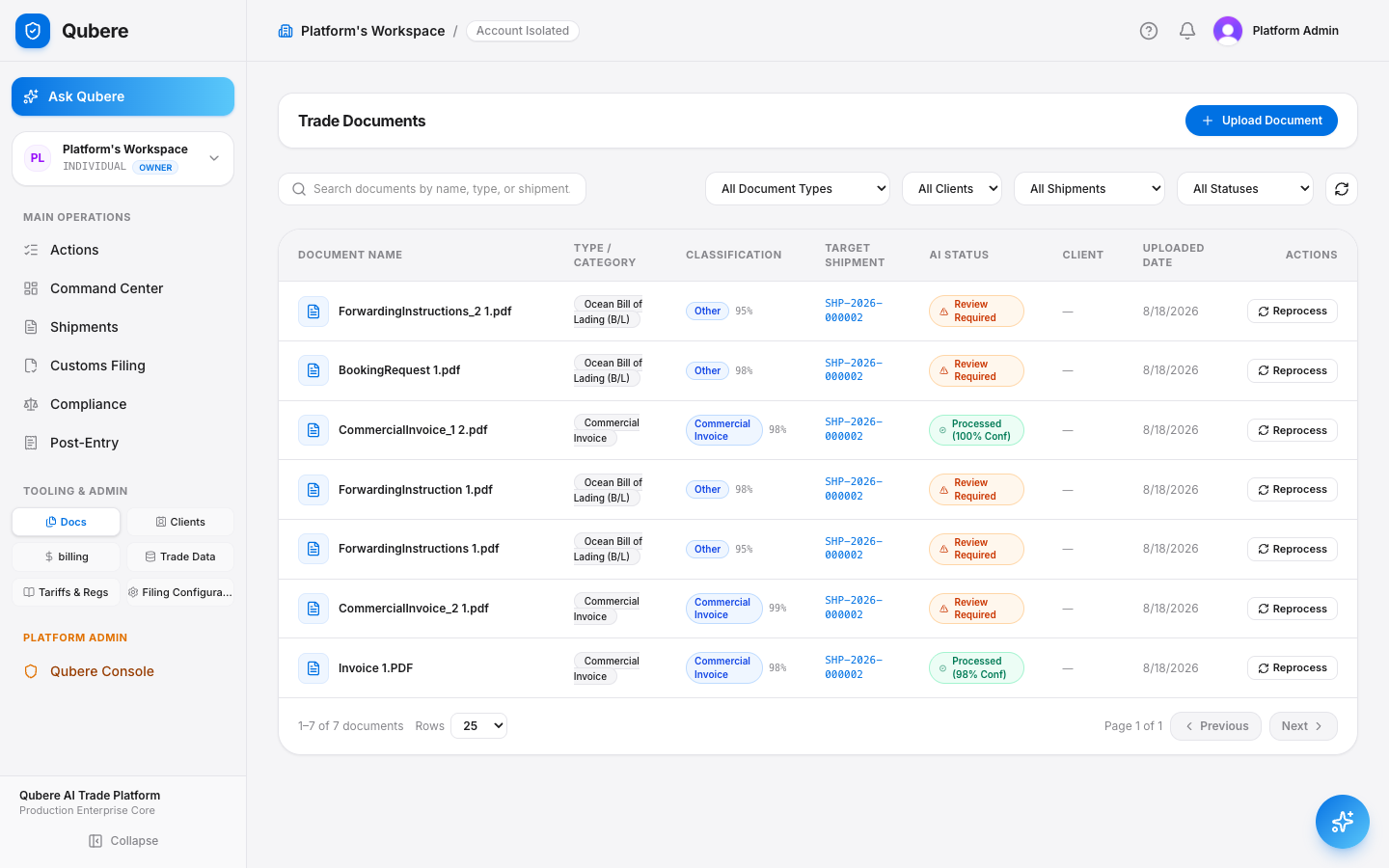
Qubere Trade Documents vault with AI extraction status per document
Live product screenshot

Decision intelligence

Product Classification & Product Master

Classification is a dedicated customs decision capability grounded in tariff reference data and controlled by confidence and review policy.

  • GRI-oriented HTS classification using product descriptions, tariff data, confidence and evidence
  • Reusable product identity, descriptions, classifications and compliance attributes
  • Duty and tariff evidence comes from ingested reference data, never model invention
  • Classification decisions remain independently persisted, explainable and reportable
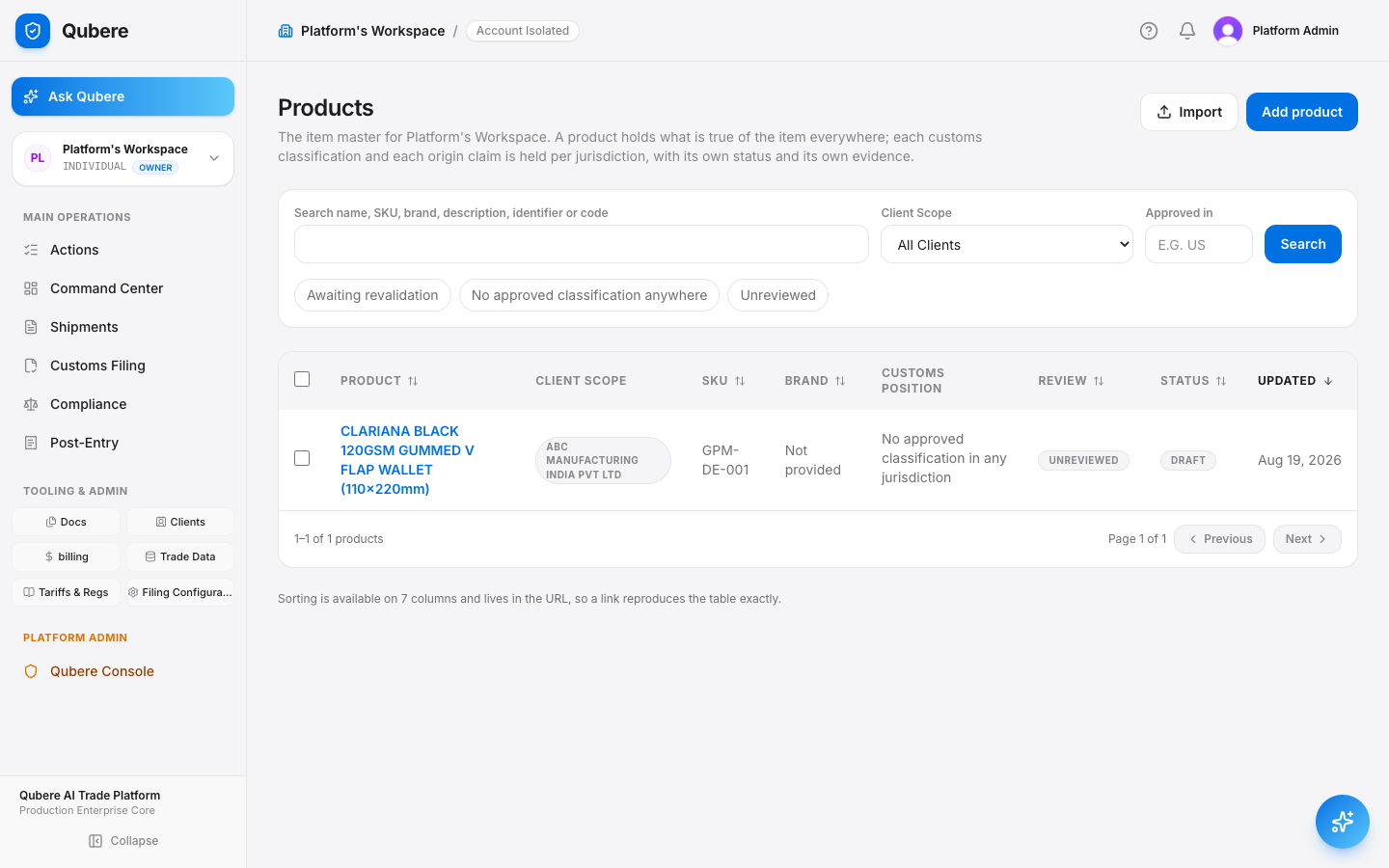
Qubere Product Master item list with classification status
Live product screenshot

Core compliance

Restricted Party Screening & Pre-Approved Parties

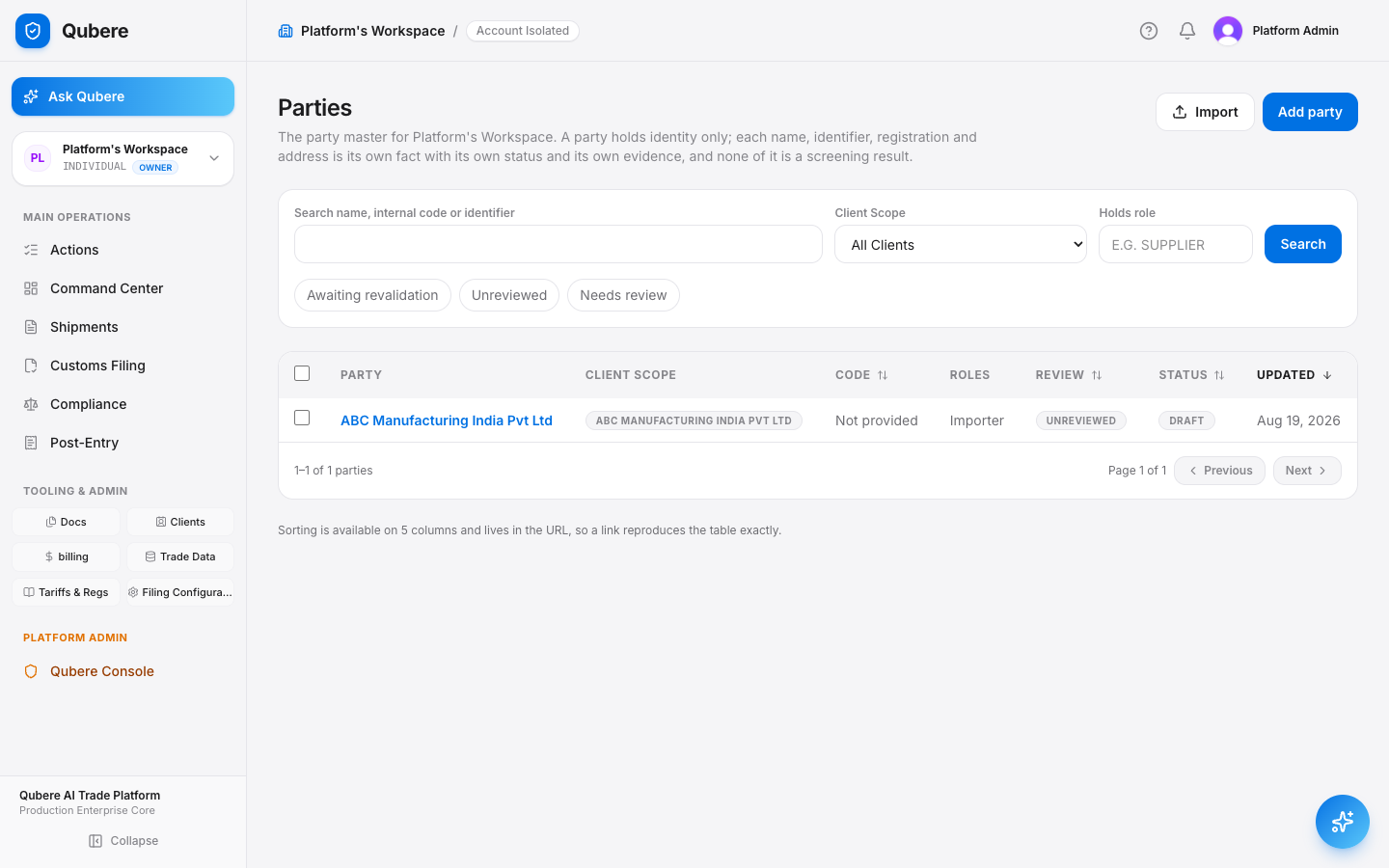
One canonical RPS capability supports Party Master, shipment, API, Community Screening, Bulk Screening and Continuous Party Monitoring.

  • Fuzzy name/address screening with thresholds, country evidence and source/list provenance
  • Live, verified address autocomplete on every party-entry form reduces screening errors from typos and malformed addresses
  • Phonetic matching (Double Metaphone or Metaphone 2) catches sound-alike names, and can be switched off per screening
  • The contact name is screened independently of the party name
  • Red-flag indicators remain visible independently of a restricted-party match
  • Matches can be assigned, reviewed, resolved and formally overridden without losing the original result
  • Fail-closed pre-approval reuse based on account, party version, and reference-data freshness
Operating principle
Technical failures, stale approvals or insufficient evidence never become CLEAR.
Qubere Party Master list with roles and review status

Beyond name matching

Network & Ownership Intelligence

A restricted-party name match is a starting point, not the whole answer — ownership, management and vessel relationships can extend risk beyond the matched name itself.

  • Graph traversal across ownership, management and vessel-identity relationships, bounded by depth and node count
  • Aggregate ownership-percentage attribution up a chain, with an explicit “ownership data incomplete” state rather than a fabricated number
  • The single most severe auto-detectable trigger — a sanctioned director/officer, conflicting relationship data, or an unresolved network relationship — opens an Enhanced Due Diligence case automatically
  • Per-account tunable trade-network risk weights and relationship data-quality thresholds, reviewable from a dashboard metric
Operating principle
Missing ownership percentages surface as an explicit gap, never a silent zero.
Compliance/EDD Case Workspace
AC
Alice · Acme
Relationship evidence
PathDIRECTOR_OF · 1 hop · currently published sanctioned entity
Aggregate ownershipdata incomplete
one case per unresolved party, idempotent
Live product screenshot

Deterministic controls

Embargo, Forced-Labor & End-Use Controls

Qubere combines deterministic country controls with specialized compliance checks and exposes rule source, severity, evidence and remediation context.

  • Compliance/ship-from country evaluated against destination/origin using active rule data
  • Account-scoped private embargo rules augment public/system controls with clear provenance
  • UFLPA/forced-labor reference data surfaces dedicated findings and evidence
  • Military end-use/end-user and anti-boycott screens run as their own checks, each with findings and evidence
  • Explicit gap states prevent unavailable data or rules from masquerading as clearance
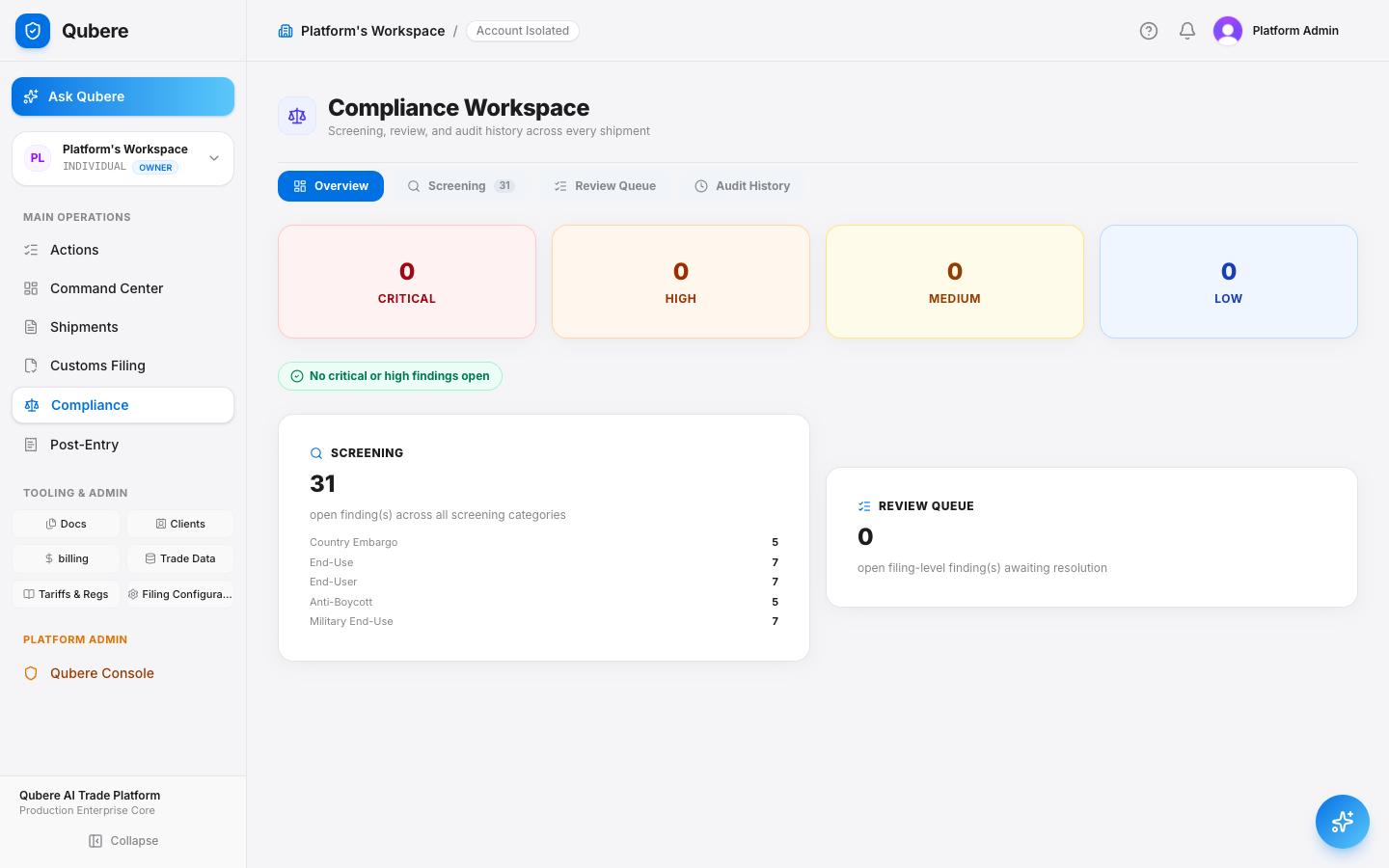
Qubere Compliance Workspace showing screening findings by category

Authorization controls

License Determination & License Management

Regulatory determination, managed-license applicability and utilization remain separate so every step is explainable and auditable.

  • Uses classification, jurisdiction, end-use/end-user, encryption and applicable control data
  • Classifications accepted as ECCN, USML, HTS, Schedule B or ICN; the US (CCL cross-reference, USML validation) and EU evaluations are separate paths
  • Dedicated encryption and replacement-parts (RPL) evaluators, plus a civilian vs. military intended-use flag that drives exception eligibility
  • Exception codes apply only when all required regulatory conditions are satisfied
  • Original regulatory outcome preserved when exceptions or overrides affect the final decision
  • Full utilization ledger — licensed, committed, shipped, adjusted and remaining — with idempotent events
Operating principle
Incomplete rule data, invalid classification or system error cannot become NO_LICENSE_REQUIRED.
License Management/Determination
AC
Alice · Acme
⚑ REVIEW_REQUIRED
Reasonsensitive end-user flag · hard stop
Evidence — what was evaluated
Classification format (ECCN)valid
End-use conditions2 true · 1 unknown
License-exception claimnone claimed
Country control-rule datasetRULE_DATA_UNAVAILABLE
utilization ledgerexpiry / utilization alerts

Flexible operations

Community & Bulk Compliance Screening

Walk-up multi-party review and enterprise batch processing reuse the same canonical compliance engines.

  • Community Screening: New Screening by Direct Entry, Select Existing Parties, or a .csv, .xlsx or .json upload
  • Restricted Party and Embargo are independently selectable; at least one must be on, and a check that was not run is shown as "Not screened for this run"
  • Runs are queued and processed in the background (Queued, Running, Completed, Partial, Failed), with a filterable history
  • Run detail: search and status filters, a per-party drawer with the party snapshot, restricted-party and embargo outcomes, pre-approved reuse with its approval ID, Rescreen Failed, and CSV or XLSX export
  • Bulk Screening takes CSV, XLSX, JSON or XML files, and a CSV import of pre-approved parties for users with that permission
  • License Determination is not part of Community Screening; the screen says so
How to demo
Both workflows orchestrate the existing Restricted Party and Embargo services — never an alternate matcher. Start a Direct Entry run, then open its detail and show the not-screened state and the export.
Community Screening/RUN-2026-0814
AC
Alice · Acme
#PartyRPSCategory
0007Nanjing Optics Import ExportMATCHCONFIRMED_MATCH
0114Dalian Hengli Group Co.0.78POTENTIAL_DENIED_PARTY
0341Hansa Components GmbH—PRE_APPROVED_REUSE
uniqueness key: (runId, rowNumber)

Proactive monitoring

Continuous Party Monitoring (RDPS)

Reference-data changes identify potentially affected Party Master records, which are re-screened through canonical RPS.

  • Published additions, updates, removals, supersessions and expirations become auditable change sets
  • Names, aliases, addresses, countries and lifecycle changes identify candidate parties
  • Candidate retrieval can over-select for safety; final decisions always come from canonical RPS
  • Material worsening transitions can create alerts, tasks, email and review work
Compliance/RDPS · Continuous Monitoring
AC
Alice · Acme
Open RDPS alerts
3
Parties monitored
2,184
Re-screened (24h)
47
Last full sweep
04:00 UTC
Change set OFAC-SDN 2026-08-28 · 62 entities added → Impacted Parties (2)
PartyBeforeAfterTransition
Severstroy OOOCLEARHITNEW_HIT
Baltic Marine LtdPOTENTIALHITESCALATED
Live product screenshot

Trusted content

Reference Data & Regulatory Intelligence

Trusted, versioned reference content underpins deterministic compliance and grounded Agentic Customs experiences.

  • Direct government ingestion for OFAC SDN and applicable consolidated non-SDN content
  • BIS screening-list ingestion and DHS UFLPA forced-labor entity reference data
  • Licensed Dow Jones full/delta watchlist feeds augment direct government sources
  • Provider-neutral change detection feeds RDPS only after successful/published content versions
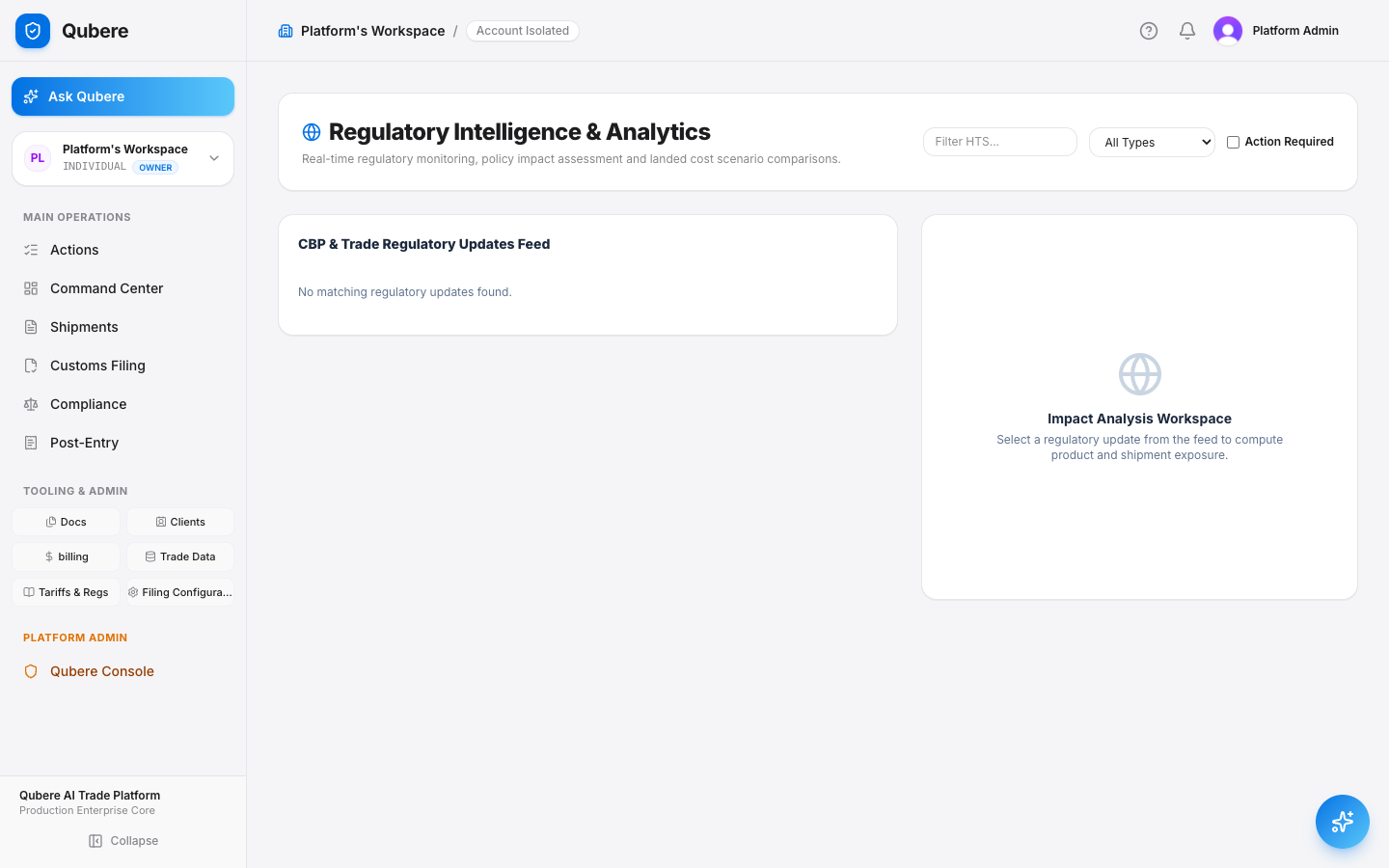
Qubere Regulatory Intelligence and Analytics feed

Controls & Monitoring

Compliance Workbench, Policies & Watchlists, and screening you can calibrate.

Comply opens on the Compliance Workbench, then groups the controls an administrator tunes: private watchlists, matcher defaults, quality, reference-data health and notifications. What each user sees follows their permissions.

  • Compliance Workbench: monitoring summary with open alerts and worsening outcomes, parties whose latest screening could not complete, and reviewer outcomes over a period
  • Policies & Watchlists: tenant-owned private watchlists whose entries are marked Deny or Review, with alternate names, entry-by-entry add, CSV import and deactivate
  • Screening Defaults: account-level name-match threshold and an optional address-similarity requirement; new screens use them and existing results are unchanged
  • Screening Quality: precision and false-positive rate computed live from analysts' reviewed dispositions, including what a different threshold would have changed
  • Reference-data health and Notifications: freshness of the lists screening depends on, and who is emailed about restricted-party hits
  • Screening result page: what to do next, why each match matched, and a disposition form to record the decision
Operating principle
Screening Quality is a live calculation from reviewed decisions, not a governed report; with no reviewed dispositions on file it says so instead of showing a rate.
Controls & Monitoring/Policies & Watchlists
AC
Alice · Acme
EntryAlternate namesDisposition
Example Trading Ltd1DENY
Sample Logistics GmbH—REVIEW
CSV import · deactivate entries

Setup & Broker Standing

Compliance Setup gets a tenant screening, and Broker Compliance records the broker's own authority.

Two administrator-owned screens: a guided first-run wizard for the compliance workspace, and a profile of the broker's license, permits and officers.

  • Compliance Setup: five steps (Company Info, Catalog Import, Screening Scope, Reviewer Roles, Launch & Tour), opened from the Command Center's Start setup link
  • Screening Scope sets name and address match thresholds, auto-screening of new counterparties and embargoed-country screening
  • Reviewer Roles invites colleagues as Maker (drafter) or Checker (sign-off); the final summary lists only what was actually saved
  • Broker Compliance: license type and number, national permit number and status, ABI filer code, and the 19 CFR 111 responsible-supervision attestation with its last date
  • Permit Qualifying Officers and district permits are recorded on the profile; a filing-authority check reports filer code, permit, active PQO and license pass or fail
  • Access: Broker Compliance needs the broker_compliance.manage permission (default roles Broker Admin and Owner) and sits in Account Admin; saving Compliance Setup needs onboarding.manage
Account Admin/Broker Compliance
AC
Alice · Acme
CheckResult
Filer code on recordPASS
National or district permit activePASS
Active Permit Qualifying OfficerFAIL
Broker license number recordedPASS
Supervision attestation · PQOs · district permits

Controlled intervention

Governance, Audit, Notifications & Usage

Qubere separates automated decisions, human actions and operational side effects while preserving a defensible evidence chain.

  • Execution records link request context, domain results, findings, versions and correlation IDs
  • Append-only audit history captures lifecycle actions, reviews, approvals and revocations
  • Original decision, override decision, reason, actor and timestamp remain visible
  • Execution History: one cross-domain record of compliance runs with search and summary on the same filters, formal overrides with who, when and the original and overriding decision, and model and prompt version where AI was used
  • Provider-neutral queue/dispatch architecture for screening, pre-approval and license notifications
  • Usage metering: completed restricted-party, embargo, private-watchlist and vessel screenings each record a usage event for the account, tagged by service type and rated into billing
Operating principle
Notification, reporting and usage-metering failures never change the authoritative compliance decision.
Evidence & Reporting/Audit History
AC
Alice · Acme
TimeActionEntityActorSrc
12:41:07RPS_RESCREENPTY-4471J. KesslerUI
12:39:55EMBARGO_SCREENSHP-2026-000188systemPIPE
09:15:40COMPLIANCE_FORMAL_OVERRIDE_CREATERES-11902D. OseiUI
ComplianceNotification → Dispatcher (outbox)

Evidence and security

Compliance Reporting & Enterprise Controls

Qubere turns persisted compliance evidence into operational and audit-ready reporting while enforcing tenant authorization independently of report filters.

  • Compliance audit reports: execution, findings, reviewer actions and override evidence
  • Screening & monitoring reports: RPS, Embargo, Party Compliance, RDPS and Reference Data Changes
  • Classification & license reports, plus saved/scheduled report definitions with run history
  • Document Extraction Accuracy report: every review verdict recorded against the parser provider/version that produced it, aggregated by field and document type
  • Account-scoped data access and permission-gated sensitive actions across APIs and UI
Operating principle
Generated files are report artifacts, not authoritative records; reports query persisted domain evidence and do not recalculate compliance outcomes.
Compliance Reports/Scheduled Reports
AC
Alice · Acme
ReportScheduleLast runStatus
RPS Monthly Screening Summary1st of month · 06:00 UTCAug 1, 2026Delivered
License Utilization & ExpiryWeekly · Mon 08:00 UTCAug 25, 2026Delivered
Compliance Audit Export — Q3Quarterly—Paused
tenant-scoped RBAC on every export

Carbon border cost

CBAM Carbon Border Exposure

EU and UK CBAM run as separate, dedicated jurisdictions — own tables, own scope rules, own regulatory data — so a cost figure is never a click away from its source citation.

  • Account-wide exposure overview: embedded emissions, actual-vs-EU-default split and a world map of exposure by country
  • Cost Radar resolves regulatory cost across every trading country at once, with saved scenarios
  • Calculator captures Quick/Advanced per-shipment runs, actual-vs-EU-default emissions as a recorded choice, and carbon price already paid at origin
  • Live-fetch adapters stage new EU/UK regulatory source updates automatically but never auto-activate
  • One CBAM Intelligence workspace under Comply: Manage (Imports, Suppliers, Production Facilities, Emissions, Benchmarks), Analyze (Overview, Exposure Map, Costs, Certificates, Annual Declarations, Quotes, Hedging) and Explore (Calculator, Code Check, Code Comparison, Regulatory Data)
  • Visible only to accounts with CBAM enabled and users with CBAM access — and the Copilot's CBAM tools follow the same gate
Operating principle
Missing or incomplete assessment data is flagged explicitly — it never renders as €0 exposure.
CBAM Intelligence/Cost Radar
AC
Alice · Acme
CountryCost / tonneStatus
Germany€41.20Resolved
China€58.90Resolved
India—Missing default value
Regulation (EU) 2023/956 Annex · benchmark v3

Qubere

Agentic Customs and Compliance —
One Connected Control Plane

Customs operations, AI agents, compliance controls, licensing, continuous monitoring, regulatory intelligence, governance and evidence — connected through a single platform.

Command CenterQubere AI CopilotDocument IntelligenceCustoms FilingClassificationRPS Pre-Approved PartiesNetwork & Ownership IntelligenceEDD WorkflowEmbargoUFLPA / Forced LaborEnd-Use / End-UserLicense Determination License ManagementCommunity ScreeningBulk ScreeningRDPSReference Data Changes Regulatory IntelligenceOverrides & AuditNotificationsReportingTenant Isolation & RBACPost-Entry & AD/CVD MonitoringFTA / Trade AgreementsAssistant Grounding & StalenessAddress IntelligenceAI Model RoutingConfigurable Filing FormsCBAM Carbon Border Exposure

Agentic AI coordinates the work. Deterministic rules govern regulated decisions. Human experts control exceptions and overrides. Every material action remains traceable.